The VMSG Annual Meeting 2027 is proud to host four workshops covering QGIS for volcanologists, advances in thermodynamic modelling of volcanic processes, creative interdisciplinary communications, and Glaciovolcanic risk. The workshops will be held on the morning of Wednesday 6th January in the Department of Earth Science, are £20 each, and include lunch and refreshments.
Additional hour-long activities will be hosted throughout the morning free of charge alongside workshops, including the ECR roundtable, a seminar on ‘How to get published’ by Cambridge University Press, a short session on laser ablation trace element analysis, and a guided tour of the Sedgwick Museum of Earth Sciences. These activities do not include lunch or refreshments. Please note some of these activities run at the same time.
Please note that all four of the workshops run on the morning of 6th January: you can only choose one. If you intend to attend a workshop, you will not be able to attend an activity at the same time.
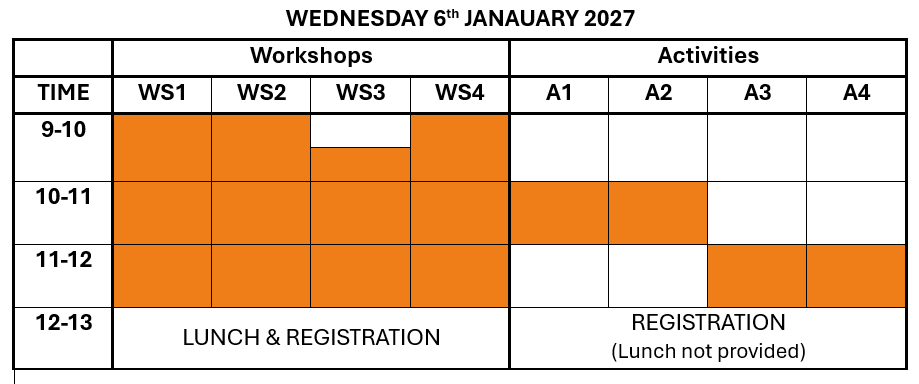
Sign-up for workshops and activities is completed at the time of registration. For more information on workshops, please email Charlie Wallace (cvw31@cam.ac.uk).
Workshops
Workshop 1. QGIS for Volcanologists
- Wed 6 Jan from 9 am-12 pm
- Co-ordinated by Simon Passey (CASP)
- £20 per person
- Maximum 20 people
This workshop is aimed at volcanologists with little or no previous experience of QGIS, a free and open-source Geographic Information System (GIS). Through a series of practical exercises, the workshop will provide a basic introduction to using QGIS for volcanological applications.
Participants will learn how to access online geological and volcanological datasets, including the Global Volcanism Program’s Volcanoes of the World; import their own data, such as whole-rock geochemistry; digitise features such as lava flows; and visualise spatial and geological data. The workshop will also introduce simple spatial analysis, including the interpolation and contouring of data to produce, for example, tephra isopach maps, and demonstrate how plugins such as Data Plotly and Geochemistry Plotting Tools can be used to explore geochemical data in a spatial environment.
The practical exercises will, where possible, use examples from Iceland to provide a common geographical theme throughout the workshop.
Participants will need to bring their own laptop with the current long-term release (LTR) of QGIS installed before the workshop. Details of any required plugins and workshop datasets will be provided beforehand.
Workshop 2. Advances in thermodynamic modeling of volcanic processes using MELTS and the ENKI software ecosystem
- Wed 6 Jan from 9 am-12 pm
- Co-ordinated by Simon Matthews (University of Iceland)
- £20 per person
- Maximum 30 people
This workshop will introduce users to the fully revamped and optimized version of the ENKI thermodynamic modeling ecosystem and to the latest developments in modeling volcanic and magmatic processes. We will showcase a selection of ENKI’s suite of open-source thermodynamic modeling tools (www.enki-portal.org), with a focus on how ENKI’s ThermoEngine software package provides easy access to the entire suite of MELTS models across all operating systems. Recent improvements to the ThermoEngine software now make it even easier for users to interact with thermodynamic models via simplified user interfaces, straightforward local installation, and/or cloud access. At the same time, technical improvements have made MELTS calculations significantly faster and more robust.
Participants will learn through practical hands-on exercises and live demonstrations, performing simulations of magma generation, crystallization, fractionation, and magmatic fluid exsolution. Participants will have the opportunity to apply these models to their own datasets and applications under guidance of the workshop organizers. We will demonstrate some of the new models and tools we are currently developing, for example MELTS calculations with Bayesian uncertainties. Finally, participants will have the opportunity to explore a variety of applications built on top of the ENKI framework, including the VapoRock outgassing simulator, the VESIcal H2O-CO2 solubility calculator, and our web-based gallery of thermodynamic teaching exercises.
The workshop will be hands-on, with attendees learning how to use ENKI software tools through lightweight online interfaces (using myBinder), or by installing locally onto their own machines. Participants should bring their own laptops for hands-on exercises, which will occupy the majority of this workshop. No prior knowledge of coding, or the ENKI ecosystem, is required. For users experienced in thermodynamic modeling, we will provide a short overview of how modelers might begin to modify and contribute new modeling capabilities to the ENKI project.
Workshop 3. Creative interdisciplinary communications
- Wed 6 Jan from 9:30 am-12 pm
- This workshop will be co-ordinated by Amy Donovan, Lara Mani, and Clive Oppenheimer (University of Cambridge) and Blaise Mafuko Nyandwi (University of Goma) and members of the VMSG community.
- £20 per person
- Maximum 25 people
This workshop will bring together people interested in using creative methods in science and risk communication in volcanology. It will feature a combination of exercises, provocations and ample time for discussions around approaches to communication both within and beyond volcanology. Anyone interested in contributing a short (5-minute) provocation based on a case study is welcome to contact the organisers. Experience in communication work is not necessary.
Workshop 4: Glaciovolcanic risk: challenges and future directions
- Wed 6 Jan from 9 am-12 pm
- This workshop will be co-ordinated by Max Van Wyk de Vries
- £20 per person
- Maximum 25 people
The August 2026 Nepal-Tibet disaster serves as a stark reminder of how dangerous glaciated regions can be – and some of the world’s most dangerous glaciers are located on active volcanoes. Considerable progress has been made on understanding both the mechanics and potential impacts of glaciovolcanic systems since the 1985 Nevado del Ruiz disaster, yet many challenges remain. The objective of this interactive workshop will be to assess what the current state of research into glaciovolcanic hazard and risk is, where the biggest gaps lie, and what the pathways are for future research. The workshop is intended for a broad VMSG audience, including those with direct experience of glaciovolcanic research and a general interest in the field, and will combine short introductory talks with group discussion and synthesis.
Activities
Activity 1: ECR Roundtable
- Wed 6 Jan from 10 am – 11 am
- Co-ordinated by Luke Hepworth (VMSG ECR REP)
- Free
- Maximum 20 people
The ECR roundtable is a safe, non-judgmental space for ECRs (which also includes all postgrads) to discuss topics that aren’t discussed as openly as they should be, like our mental health. Each roundtable has a theme, with some of our past themes being rejection and self-esteem or generally messing things up. However, we usually get derailed and just chat about what’s on our minds that day. Sometimes, we just complain about the weather!
The VMSG2027 Roundtable theme will be a year in review. How did your year go? Was it a total and unmitigated disaster because a mass spec exploded? Was it amazing because you had an abundance of GLORIOUS weather on your fieldwork? Come and chat about it!
This ECR Roundtable will also serve as a meeting point ahead of the main conference, so if you’re not attending one of the other workshops and want to meet some people and hang out, sign up!
If you have any questions regarding the roundtable, please don’t hesitate to send an email: lh907@cam.ac.uk.
Activity 2: Recent advances in micro-analysis
- Wed 6 Jan from 10 am – 11 am
- Led by Sally Gibson, David Douglas (ESL), and Richard Taylor (Zeiss)
- Free
- Maximum 15 people
This session will explore the use of new developments in the imaging and analysis of major and trace elements in igneous rocks.
Activity 3: ‘How to get published?’ by Cambridge University Press (CUP)
- Wed 6 Jan from 11 am -12 pm
- Led by Monica Moniz and Susie Francis (Cambridge University Press)
- Free
This will be a presentation and conversation on scientific publishing by Monica Moniz and Susie Francis from Cambridge University Press & Assessment. Monica will focus on STM journals publishing and discuss perspectives on why publish, peer review, AI, ethics and other publishing trends. Monica will also offer practical advice on how to choose where to publish, how to become a reviewer for your favourite journal or a member of its editorial board. Susie will briefly describe the role and process of book publishing in the sciences, and how it differs from journals.
Activity 4: Guided tour of the Sedgwick Museum of Earth Sciences, Downing Site (Fully Booked).
- Wed 6 Jan from 11 am-12 pm
- Free
- Maximum 20 people per tour
Led by the Sedgwick Museum team, this guided tour will take you through some of the museum’s collections, including the William Smith map, and some of the museum’s volcanic and igneous samples from the collections centre, brought out for VMSG. Tours are limited to 20 people; if there is popular demand, then we may arrange additional times and dates during the conference. Find out more about the Sedgwick Museum: https://sedgwickmuseum.cam.ac.uk/.